For couples who refuse to choose between who they are
Most multicultural couples arrive having already done the hardest work. They have sat with both families. Navigated the competing expectations, the traditions that carry decades of meaning on one side and require careful explanation on the other. They have held it together — thoughtfully, diplomatically, and often exhaustingly.
What they need now is someone who takes the rest completely off their hands. Not a planner who accommodates culture. One who understands it.
There is a difference — and most couples who have spoken to generic wedding planners know exactly what that difference feels like.
What We Do
Culture expressed at its absolute best not as a gesture, but as the architecture of the day.
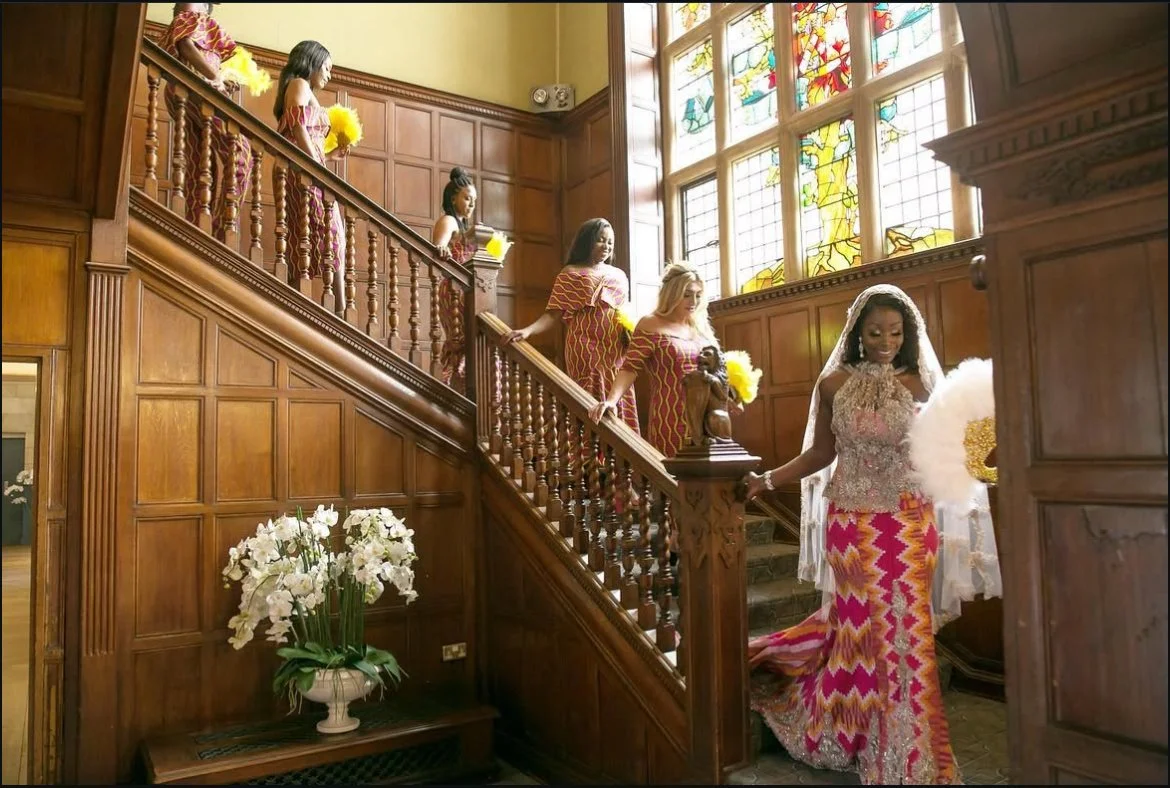
We have planned celebrations where the Yoruba Iyawo procession opened a weekend that would span three days. The bride arriving in full Aso-Oke fabric sourced with intention, gele tied to architectural perfection by a specialist brought in for that day alone. The Eru Iyawo presented with full ceremony. Kola nut broken with the gravity it demands. Libation poured. Talking drums filling the room with the kind of energy that only a West African celebration, executed properly, can generate.
And then the following evening the same couple, the same families, the same weekend — walking into a reception that would not look out of place in the pages of Vogue. A venue dressed at the level of a couture house. Florals that took a lead designer and a team of six two full days to install. A menu developed with a Michelin-trained chef who understood that jollof rice served at this standard is not a compromise it is a statement. A live band moving through Afrobeats, soul, and an orchestra arrangement of the couple's first song without a single dropped note. Lighting that transformed the room three times across the evening.
We have planned Igbo celebrations where the Igba Nkwu wine-carrying ceremony carried its full spiritual and familial weight before a church blessing of equal elegance, followed by a reception that began at six and was still moving at two in the morning. Ghanaian weddings where the knocking ceremony on the first day was as meticulously designed as the international reception on the second because both deserved it, and the families had waited too long for anything less.
For West African celebrations, the spend is not incidental to the culture. It is an expression of it. The big wedding is not excess. It is honour. We plan to that understanding and source accordingly the Aso-Oke designer whose waiting list runs six months, the gele artist who has dressed brides from Lagos to London, the caterer who has cooked for five hundred and made every plate feel individual, the MC who understands a Nigerian room and can move it from laughter to tears to dancing without breaking the evening's rhythm.
Across other traditions we bring the same depth. A Nikah conducted with the Wali present, the Mahr properly honoured, the proceedings held with the solemnity they require before a Walima reception where cultural richness and international luxury arrived in the same room simultaneously. A Jewish-Ghanaian couple who wove the lighting of the Hanukkah menorah into a December weekend in the English countryside the Chuppah standing in a garden dressed to a level that made guests catch their breath, and a reception where both heritages were held with equal reverence, neither requiring explanation.
]
Multi-Day Celebrations
When two cultures come together, a single day is rarely sufficient to do them justice. The multi-day format is often not a preference — it is the only structure that gives each tradition the space and authority it deserves without compression or compromise.
We design multi-day programmes where each day carries its own identity, its own emotional arc, and its own cultural integrity — while the whole unfolds with coherence and a pace that allows guests to be fully present. Whether across a private estate in the English countryside, a château in southern France, a resort on the East African coast, or a sequence of locations spanning more than one country, we manage every element from first arrival to final farewell.
The couple experiences the day. We hold everything else.
Cultures We Plan Across
-
-
-
-
-
Jamaican, Trinidadian, Barbadian
-
Ashkenazi, Sephardic, Mizrahi
-
Wolof, Mandinka, Fula traditions
-
French, Italian, German
-
What We Deliver
-
-
-
-
-
-
-
Full management of multiple outfit changes across traditional, ceremony, and reception looks, including coordination with cultural dressers, gele artists, and international fashion houses.
-
Officiants, musicians, gele artists, fabric specialists, and caterers sourced specifically for their expertise in the traditions involved — not generalists who will learn on the day.
-
Cultural briefings, welcome communications, and bespoke hospitality design for international guests travelling from multiple countries — ensuring every guest understands and feels the celebration from the moment they arrive.
"If you ever doubted if you met my standard — be reassured that you have surpassed it."
—Dr Jovita Ukpo